Dasanjali Lesson 1 - introduction to music in general and Hindusthani music in particular
Welcome to the Dasanjali school of devotional music, based in the U.S.A. This is a continuation of good work in spreading Indian classical music, started by my uncle, the late Sri M.O.Srinivasan in Madras, India in the ‘60s. He was also an excellent wicket-keeper who represented India in Cricket test matches.
Most of the songs taught in this school will be set in the Hindusthani style although there may be a few set in the Carnatic style as well. The lyrics for the songs will be in different languages. The embedded music clips and songs in these lessons will be typically in mp3 format, although some of them may be in wmv or Real Audio format. While the Real Audio songs typically require you to download a RealAudio player from real.com, the other formats may be played using the RealAudio player, Windows Media Player (standard on most Windows machines) or QuickTime.
What are the essential elements in any music?
Tune
Beat
Without these two elements, there will not be any music at all anywhere in the world. e.g. Try just READING the song Twinkle Twinkle or any favorite song of yours and see how boring it sounds. Then, try singing it to a wrong beat or no beat at all and see how bad it sounds.
There are many “styles” of music around the world:
Rock-and-roll
Reggae
Country music
Hip-hop
Persian
Asian – Japanese, Chinese
Last but not the least, Indian …
In all styles of music, you have both vocal and instrumental music.
Indian music can be categorized in several ways:
Film music
Hindi
Tamil
Bengali …
Folk music
Pongal songs
Holi songs …
And certainly last but not the least, Indian Classical music
Hindusthani music – originated in North India
Carnatic music – originated in South India
Getting back to the two essential elements of music, in Hindusthani music,
a Tune is known as a Raag and
a Beat is known as a Taal
Some basic info on “raags” and notes:
All raags are formed from basic “notes” known as “SRGM…” in Hindusthani music.
When you sing the notes upwards, i.e. in higher and higher pitches, that is called an Aaroha.
When you sing the notes downwards, i.e. in lower and lower pitches, that is called an Avaroha.
You generally start the first note (S) on a key that is comfortable for your voice, but still a slight challenge so the music comes out good and strong when you sing.
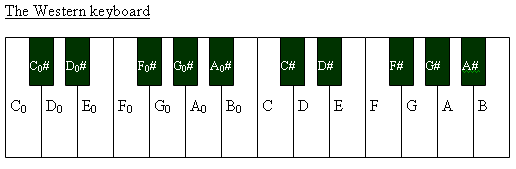
I typically recommend the Western note A, the 6th white key from the left on a keyboard.
NEVER slouch when singing and NEVER sing from only your mouth or throat. ALWAYS sit up straight, take deep breaths whenever possible and sing straight out from your navel/stomach area.
e.g. Try singing one line of Twinkle Twinkle or any favorite song of yours repeatedly in a loop using the first method (slouching, singing from your mouth/throat) and then using the second method (sit up straight and sing from your navel). You will notice that you can repeat the line at least a few more times using the second method.
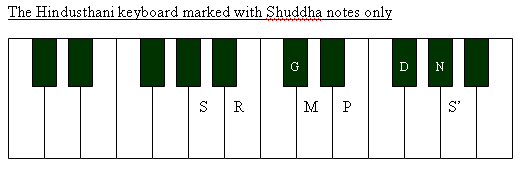
Shuddha or regular notes in Hindusthani music:
	S	R	G 	M 	P 	D 	N 	S’
	S’	N	D	P	M	G	R	S
Practice Aaroha and Avaroha a few times daily using both the notes themselves (SRGM…) and then the Aah sound sung to the same pitch.
You may practice your SRGM and Aakaars (the Aah sounds instead of singing the notes themselves) either using a real keyboard or piano or an online keyboard. I found a good online keyboard at http://www.apronus.com/music/flashpiano.htm based on which I have marked the keys you need to practice singing for.
The lower S and the higher S’ are distinguished when writing using a dot (.) on the higher S’. Since such a letter/font was not easily available on the computer, I am using an apostrophe or single quote instead when typing.
Practice Aaroha and Avaroha tunes:
(Aaroha) S R G M P D N S’
(Avaroha) S' N D P M G R S
(Aaroha) SR RG GM MP PD DN NS’
(Avaroha) S’N ND DP PM MG GR RS
Finally, in this class, we must have fun also. I derive a lot of fun by actually singing songs with words, especially in different languages (even if I cannot always understand what they mean). So, being the first class, we start with a couple of auspicious songs on Lord Ganesha and Goddess Sarawathi.
Lord Ganesha song: Gaja Vadana Beduve
Goddess Saraswathi song: Saraswathi Shaaradha Maayee
My uncle would try to start most songs with a sloka and you will notice that in the above songs.